24 March 2023
VUCA Leadership: 8 Essential Strategies for Leading Through VUCA
These exceptional times require exceptional VUCA Leadership to stand up and be counted.
24 March 2023
These exceptional times require exceptional VUCA Leadership to stand up and be counted.
Perhaps the first to describe a VUCA world (Volatile, Uncertain, Complex and Ambiguous) were Bennis and Nanus (1985). Present day, Covid-19 has been a catalyst that sees many businesses starting to accept the concept of a VUCA World. We cannot continue to create a better world by doing what we have always done. These exceptional times require exceptional VUCA leadership skills to stand up and be counted.
It’s worth asking yourself a few questions:
Here are just some of the questions that should ignite that fire inside to lead through VUCA. Even those with extensive experience may be surprised to hear that this doesn’t guarantee they will have the right skills or strategies in place when leading through VUCA.
–
A great way to help transform a VUCA situation is to turn it on its head. You will be surprised to see what solutions can arise as a result. At TNM we use the following to help turn chaos into clarity:
–
Jon Mertz (2014) highlighted the DURT model. He explains that when leading through VUCA, leaders should be Direct, Understandable, Reliable, and Trustworthy.
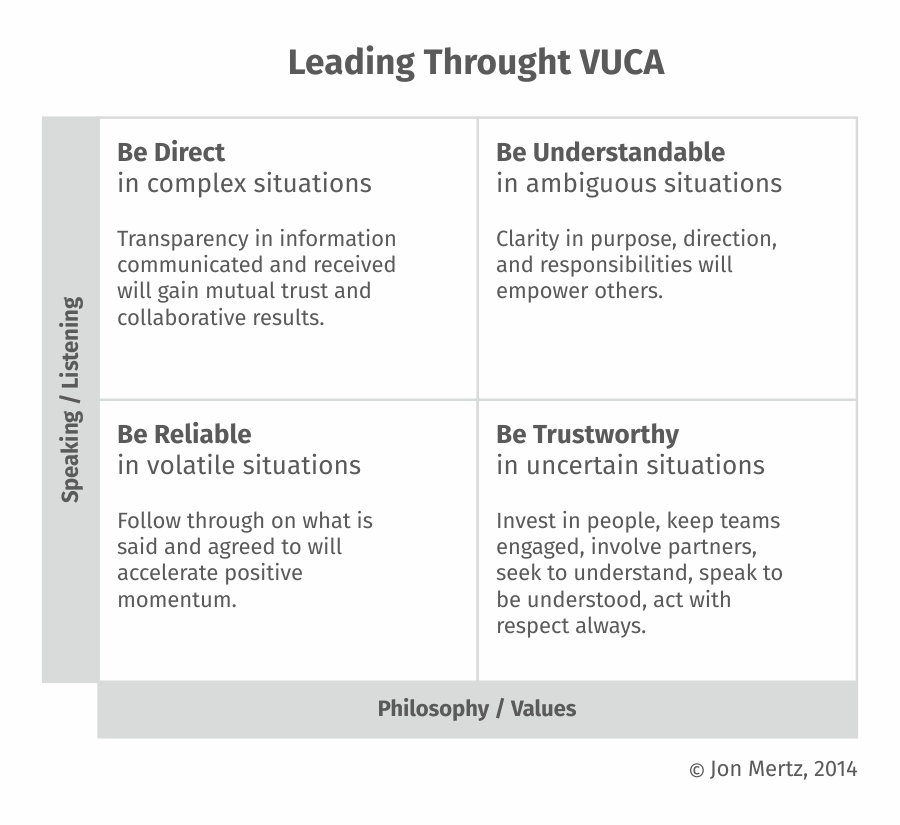
He goes on to explain why leaders cannot match VUCA with VUCA characteristics but that we need to actively build on the DURT characteristics to inspire our teams.
–
At TNM we believe that even through the most difficult, chaotic times we can create opportunities. These situations are often the breakthrough you need to find true business success. We’ve put together our eight core strategies to help you maximise these opportunities and ensure you not only survive but also thrive, as you lead through VUCA times.
Developing cognitive flexibility enables you to envision multiple scenarios, develop different solutions simultaneously, and pull the plug and move on when an approach isn’t working – (Colvin, 2020).
The pandemic has taught us to evolve and adapt quickly: there has never been a period of time where we have had to adapt, stop, and start strategies as quickly as we have done recently. Cognitive flexibility supports your ability to think of different strategies without getting too attached to any one of them. Staying on your toes and being fully aware of all the opportunities is paramount when they arise in VUCA leadership.
“Most organizations do not rise to the level of their goals. They fall to the level of their systems.” (Grier, 2021)
It’s great having a goal but you can set yourself up for failure without having strong systems and processes in place to get you there. As well as thinking about the end goal, it’s vital to determine the steps and infrastructure you need to get you there. Systems and processes are an ever-changing beast, so the sooner you get started with them the more flexible and responsive you can be in the future.
Organisations are increasingly putting people first. When we focus on creating the right culture that is authentic, accepts vulnerability and promotes open conversations, teams collaborate better. Focusing on this collaboration means you can celebrate the successes of every single person and work on supporting one another which naturally results in success when leading through VUCA.
“I’ve got 99 problems but VUCA ain’t one.” (TNM, 2022)
Having problems isn’t necessarily a bad thing. The danger arises when we do not have the right culture in place to solve them. One way to do this is by creating a coaching culture that helps you to face problems head-on and ask the right questions. A coaching culture allows leaders to find out who needs support and identify priorities. Creating this type of culture empowers those leading through VUCA times to find the opportunities that lie within the challenges ahead, and thrive during times of disruption.
Businesses run on schedules, meetings, and forecasts. We have been conditioned to know that intentional planning creates purposeful implementation. However, in these volatile times, we need to take a step away from the rigid restrictions and move towards flexibility. Moving with, and adapting to the change and using systems and processes to support you is crucial when leading through VUCA.
“Egon Zehndeaving conducted an analysis of executives’ performance over a 30-year period wherein they reported curiosity as the only one of four traits (the others being insight, engagement, and determination) to be correlated with all eight leadership competencies that the firm deemed critical to a leader’s success.” (Dr. Alison Horstmeyer, 2020)
Curiosity can be overlooked when it comes to leadership strategies and skills. However, it is fundamental for being a catalyst for creativity, managing change, and successful problem solving. Through curiosity, we learn to ask the right questions, form a natural desire to dig deeper into situations, and this results in clarity when leading through VUCA.
“Execution thrives with simplicity and transparency. Execution doesn’t like complexity. As complexity increases it becomes more difficult to maintain focus.” (McChesney, 2020)
Don’t be a VUCA leader and create more ambiguity and complexity. It can be easy to panic and want to throw your energy into lots of ideas at the same time. The best thing you can do for yourself and your team is to focus on doing one thing well.
“Do rapid prototyping that allows you to fail early, fail often and fail cheaply — while learning along the way.” (Johansen, 2018)
Yes, we may be borrowing Nike’s strapline here, but it helps to demonstrate one very important point. In VUCA climates the key is to ‘Just do it’. As a leader, it’s your responsibility to promote rapid prototyping and proof of concept. When leading through VUCA, don’t invest heavily in creating perfect prototypes without knowing whether your audience is going to actually connect with it. Instead, you should work on innovations by creating a solid proof of concept that allows you to adjust and move forward toward success when leading through VUCA.
–
There are many strategies you can adopt when leading through VUCA. These are extraordinary times we are currently in. Our leaders of today can create a better world for tomorrow, however, it is up to them to develop and inspire the next generation of leaders. Will they instill the wisdom required to adapt and create clarity during VUCA times? What role will you play, what leader will you become and are you prepared to step up to the responsibility required to take us collectively forward?
If you would like to explore how TNM can support your organisation in developing leaders to rise to the challenge of VUCA leadership, book a no-commitment discovery call with one of our consultants.